
SOC 2 Penetration Testing Services
Your auditor wants evidence. Your enterprise prospects want proof. One report should satisfy both.
SOC 2 audits are won or lost on evidence quality. The Trust Services Criteria don’t prescribe exactly how you demonstrate risk identification and control effectiveness, but they do require that you demonstrate it. A penetration test is the most credible form of that evidence available, and the difference between a report that closes the control cleanly and one that generates follow-up questions from your auditor almost always comes down to whether the work behind it was real.
Many SOC 2 pentests aren’t real. A scanner runs, the output gets dumped, and the auditor accepts it because the box is checked. That works until it doesn’t, which is usually when an enterprise prospect’s procurement team asks to see the report and finds that the methodology section is thin, the severity ratings are automated, and there’s no evidence anything was actually fixed.
The pentest you do for SOC 2 is also the report you’re going to hand to your biggest customer. It’s worth doing once and doing it right.
What SOC 2 Actually Requires
The framework doesn’t mandate a penetration test by name, but the controls it does require are hard to satisfy credibly without one. CC4.1 asks whether you’ve conducted proactive risk assessments across your systems. CC7.1 asks whether you have processes to identify and monitor threats. CC7.2 asks whether you can detect unauthorized access or changes. CC6.1 and CC6.6 address access controls and vulnerability management.
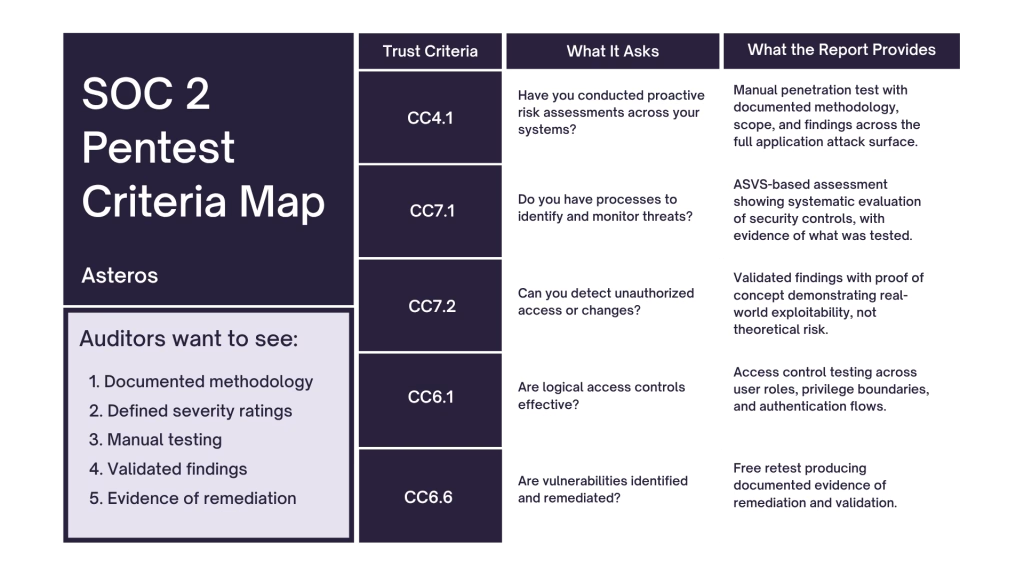
A well-scoped penetration test with documented findings, validated remediation, and a retest result answers all of those questions with evidence that’s difficult to challenge. A scan that found nothing raises them.
How Asteros Runs SOC 2 Engagements
We start with a scoping call built around your audit timeline. You walk us through the application, the user roles, the authentication flows, anything that’s changed recently. We define scope, lock in testing dates that fit inside your observation window, and you get a flat-fee service agreement with clear deliverables. The engagement runs about two weeks from kickoff to report delivery.
You have direct access to the senior practitioner doing the work throughout. Not an account manager. Not a junior tester escalating to someone more senior. The person you talk to in the scoping call is the person running the test and writing the report.
What the Report Looks Like
Three audiences are going to read this document and each of them needs something different.
Your engineers get step-by-step technical findings with validated proof of concept, reproduction steps, and remediation guidance written for your actual stack. If something is a real vulnerability, the report shows what an attacker could actually do with it.
Beyond the findings list, the report includes a structured assessment grounded in the OWASP Application Security Verification Standard, a framework for evaluating the security controls in modern web applications that auditors and procurement teams increasingly recognize by name.
Most penetration tests stop at the list of vulnerabilities. The ASVS assessment goes further: it systematically evaluates the application’s security controls domain by domain, maps findings to specific control deficiencies, documents what the application is already doing well, and captures improvement opportunities that don’t rise to the level of a reportable vulnerability. Those observations get written up honestly for what they are, gaps worth addressing, not inflated into findings to pad the report and not silently dropped because they fell below the line. Your engineers get an accurate picture of where the application stands. Your auditors get evidence of a thorough, methodical process.
Your auditors get the methodology documentation, severity ratings, and control mapping they need to close CC4.1, CC7.1, CC7.2, and the access control criteria without follow-up questions.
Your enterprise prospects’ procurement teams get an executive summary that documents methodology, severity ratings, and remediation status. The same report that satisfies your SOC 2 auditor passes a vendor security review, because when the work is done properly those aren’t two different reports.
The Retest
After your team remediates, a free retest validates the fixes and produces clean evidence of identification, remediation, and validation. That’s the closure document SOC 2 vulnerability management requirements expect. A sanitized attestation letter is available for customer sharing if you want something you can hand to a prospect without exposing technical detail.
Type I or Type II, First Audit or Renewal
If you’re preparing for a Type I, the engagement establishes a documented baseline and demonstrates that risk identification is an active process rather than a one-time checkbox. If you’re heading into a Type II or a renewal, it shows continuity and measurable improvement, which is what auditors are looking for when they’re evaluating whether your security program has actually matured.
If your last pentest was a scanner dump that cleared a lenient auditor and you’re now facing a more rigorous review or a customer with stricter vendor requirements, this is the right time to reset the standard.
SOC 2 penetration testing FAQs
Does SOC 2 require a penetration test?
The framework doesn’t mandate one by name, but the controls it does require are hard to satisfy credibly without one. CC4.1 asks whether you’ve conducted proactive risk assessments. CC7.1 asks whether you have processes to identify threats. CC7.2 asks whether you can detect unauthorized access. A well-documented penetration test with validated findings and a retest result answers all of those with evidence that’s hard to argue with. For the control-by-control detail, see the SOC 2 penetration testing requirements checklist.
How much does a SOC 2 penetration test cost?
Web application penetration tests start at $10,000 flat per app, and most apps fit that minimum. Network testing added to a web app engagement is typically $3,000 to $7,000. The price is agreed up front with no hourly billing, and retesting of fixed issues is included. See pricing.
How long does it take, and when should we schedule it?
About two weeks from kickoff to report delivery for most engagements. During scoping we lock in dates that fit inside your observation window. If you have a hard deadline tied to an audit or an enterprise deal, tell us first and the timeline is built around it.
Can the penetration test happen while the audit is under way?
Yes. What matters is that testing and the report land inside your observation window. If you’re mid-audit and missing the report, see emergency penetration testing for SOC 2.
We already have a pentest through Vanta or our auditor. Is that enough?
It might be, if the report will only ever be reviewed by a lenient auditor checking a box. The problem is that the same report often gets shown to enterprise prospects during vendor security reviews, and procurement teams are increasingly specific about what they want to see: documented methodology, a defined severity rating system, manual testing evidence, and remediation validation. Scanner-based reports frequently fail that review, and the deal stalls while you decide whether to redo the test.
What if the test finds very few vulnerabilities?
A test with light findings still produces the ASVS assessment, which documents what was evaluated and what the application is doing well. That’s what shows an auditor the test was thorough rather than cursory. Zero findings on an active SaaS application is rare and worth scrutinizing; if a test comes back completely clean, the right question is whether the methodology was rigorous enough to find anything.
Will the same report work for customer security reviews?
Yes. The report is written for three readers: your engineers, your auditor, and your customers’ procurement teams. A sanitized attestation letter is also available if you want something to share with a prospect without exposing technical detail.
“We have worked with Asteros twice and have been very satisfied with the results. Our company needed a SOC 2 audit and pen testing done, and Zach got the job done on time and with great professionalism.”
Ready to Get This Done?
The scoping call takes about thirty minutes. You walk us through the app, we talk through your audit timeline and compliance goals, and you leave with a clear picture of scope, cost, and what the engagement looks like. No obligation past that conversation.
Not sure what your auditor will expect or whether your current security posture is going to produce a clean result? Our free guide walks through what a rigorous pentest report actually looks like and what questions to ask any vendor before you sign.
Download the free guide: Audit-Proof Your Pentest →
Want the detail? See the full SOC 2 penetration testing requirements and checklist.